 Traderjoexyz
 Traderjoexyz JOE staking pays USDC rewards that vary with trading fees and pool participation
Traderjoexyz JOE staking pays USDC rewards from trading fees through the sJOE pool on Avalanche. Earnings vary with the revenue available for distribution and your recorded share of staked JOE. Deposits by other participants can change that share even when your own stake stays constant. Distribution timing also affects when rewards become claimable. Trader Joe rebranded as LFJ in September 2024. USDC rewards do not protect the staked JOE from price changes.
- updatedUSDC rewards can increase while the total value of a JOE staking position falls with the token’s market price.
Recorded JOE balances determine each reward allocation
The staking pool allocates funded rewards using each participant’s credited JOE balance relative to the total credited stake. Your share therefore has a changing denominator. If other participants add JOE while your balance stays unchanged, your proportion decreases. Withdrawals by other participants have the opposite effect, assuming your own recorded balance remains constant. A growing reward fund can offset a smaller share, so changes in personal earnings require both quantities to be considered.
For an allocation with unchanged balances, the relationship is: your reward equals the allocated reward amount multiplied by your staked JOE divided by total staked JOE. Across several allocations, the relevant balance is the balance that applied to each allocation.
USDC income leaves JOE price exposure intact
A stablecoin payout does not fix the market value of the JOE that remains in the staking contract. Rewards and principal have different units: earned USDC measures the distribution, while the staked balance measures JOE tokens. A positive reward amount can coexist with a decline in the position’s dollar value. Its total economic return includes both the rewards and the change in value of the underlying JOE, along with transaction costs. Reporting only the reward balance leaves out that price movement.
USDC can also trade above or below its dollar target on exchanges.
Comparisons need a consistent valuation basis. The USDC that has been claimed, the USDC still claimable, and the JOE still staked are separate holdings or entitlements. Adding the same claimed reward to both the wallet balance and an older pending-reward display would count that payment twice.
The protocol share controls how pool fees reach stakers
Trading volume contributes to fee income through the fee rates and protocol allocations of the pools that execute trades. A pool’s protocol share is a fraction of the trading fee that it collects. The remaining allocation can belong to liquidity providers. Consequently, a platform’s gross trading volume alone does not reveal the amount available for JOE rewards.
Joe V1 fee allocation
Joe V1 pools charge a 0.30% swap fee. The split assigns 0.25% of trade value to liquidity providers and 0.05% to JOE staking. Both percentages use trade value as their denominator. The staking portion is therefore a component of the trading fee, and a liquidity provider’s pool income represents a different allocation.
Liquidity Book fee allocation
Liquidity Book combines a base fee with a variable component that responds to price volatility. Its protocol share is configurable, so the fee income reaching stakers can vary with both trading conditions and pool settings. The types of pools used by traders matter alongside total volume. The Joe V1 fee split does not apply uniformly to Liquidity Book pools.
Token issuance and fee income follow different mechanisms
JOE’s scheduled minting has ended at its stated supply cap of 500,000,000 tokens. Some tokens can still enter circulation from existing allocations, which differs from minting new supply. The USDC distributed through sJOE comes from fee revenue rather than a scheduled JOE issuance rate. A change in circulating supply therefore does not, by itself, establish a corresponding increase in the reward fund. Revenue depends on the trading activity and fee allocations that actually feed the staking product.
Distribution timing affects the claimable balance
Reward funding arrives periodically, so exchange trading and an individual claimable balance do not need to change together. Distributions generally arrive every few days, and the claimable amount follows the funding actually received. Its accounting recognizes reward tokens available to the staking pool and allocates them across recorded stakes. Elapsed time alone does not establish that a new distribution has arrived. A flat balance between funding updates can therefore occur without a failed deposit.
The pool tracks accumulated rewards per share and each address’s previous reward accounting. That prevents an already settled amount from becoming a fresh claim merely because the staking balance changes.
Top-ups settle pending rewards before changing future participation
Adding JOE to an existing sJOE position automatically harvests pending stablecoin rewards into the staking wallet. The pending display can fall after the top-up because the payment has moved into the wallet. Its disappearance from that display does not, by itself, indicate a lost reward. The credited JOE balance then reflects the additional deposit, and that larger balance participates in subsequent reward allocations.
A top-up does not retroactively apply the larger balance to allocations already accounted for. Comparing the old pending amount with the associated reward transfer explains the reset.
APR expresses a changing income rate over a year
An annual percentage rate, or APR, expresses a reward rate on a yearly basis without assuming reinvestment. It cannot fix future fee collections or pool participation.
Rewards over a stated period
A meaningful comparison uses distributed rewards and the stake that earned them over the same period. A short observation window can include a large funding update or miss one entirely. Extrapolating either observation across a year assumes that the observed conditions continue. A displayed annual rate and the amount actually claimable answer different questions: the rate describes yield relative to a valuation basis, while the claimable amount describes an existing entitlement.
Valuation and reinvestment assumptions
The value assigned to staked JOE
When a percentage expresses USDC income relative to the dollar value of JOE, the JOE valuation affects the denominator. A lower token valuation can raise that percentage even if the USDC income is unchanged. It does not increase the number of reward tokens or compensate automatically for a capital loss.
The treatment of claimed rewards
Annual percentage yield, or APY, includes compounding assumptions. Receiving USDC does not automatically add JOE to the staking balance. Reinvestment requires acquiring additional JOE and depositing it, exposing that conversion to its own execution price and costs. An assumed compounding schedule therefore changes an estimate without creating automatic compounding in sJOE.
Network costs reduce the income retained from claims
Avalanche C-Chain transactions require AVAX for gas, while the staking rewards described here arrive in USDC. Depositing, claiming, and withdrawing involve contract execution, with gas costs determined by the transaction and prevailing fee conditions. A top-up can harvest rewards within the same transaction that adds JOE. LFJ documents no staking deposit or withdrawal fees, although the contract has an owner-configurable deposit-fee setting. If that setting is nonzero, the credited stake excludes the deposit fee. Network gas remains a separate cost, regardless of that setting.
Frequent claiming changes the number of transactions paid for. It does not increase the fee revenue assigned to the position.
If claimed USDC is converted into JOE for reinvestment, the swap’s execution cost also affects the additional stake acquired. Pool trading fees and network gas have separate calculation bases; gas pays for blockchain execution.
A staking request needs a matching recorded deposit
For a JOE deposit, the expected result is an increase in the staking balance recorded for the submitting address. Before submission, the selected pool must accept deposits on the wallet’s network. The wallet also needs sufficient JOE, transaction-fee funds, and any required token allowance. An allowance permits the staking contract to transfer JOE; it does not itself create the recorded stake.
- Continue only when the selected pool accepts deposits and the wallet holds the required balances on that network.
- Complete any required JOE approval before submitting the deposit that depends on it.
- Wait while the deposit is pending; a transaction identifier alone does not establish successful execution.
- After success, compare the credited increase for the same pool and address with the deposit amount after any applicable deposit fee.
- Stop further deposits if execution failed or the recorded increase does not match; resolve that discrepancy before adding JOE again.
A successful deposit establishes participation, even when the reward balance has not yet increased. The pool issues no receipt token, so its recorded JOE balance confirms the stake; a later reward allocation establishes the claimable amount.
Withdrawal rights and deposit availability follow the selected pool
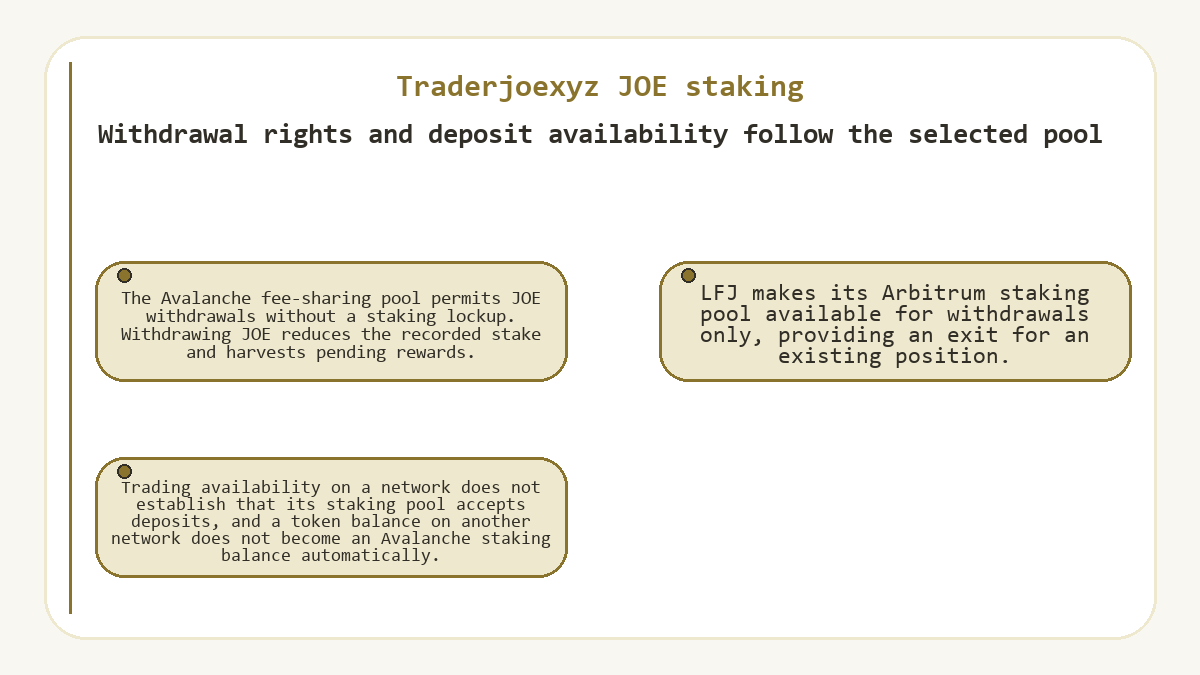
The Avalanche fee-sharing pool permits JOE withdrawals without a staking lockup. Withdrawing JOE reduces the recorded stake and harvests pending rewards. LFJ makes its Arbitrum staking pool available for withdrawals only, providing an exit for an existing position. Trading availability on a network does not establish that its staking pool accepts deposits, and a token balance on another network does not become an Avalanche staking balance automatically.
Reverted transactions differ from an incomplete display
A reverted staking transaction leaves its attempted token transfers and accounting changes unapplied, although the execution can still consume gas. An interface that has not refreshed can instead omit a completed reward payment. The transaction receipt identifies execution success or failure; reward-transfer records identify the asset, recipient, and amount actually paid. A zero pending-reward display alone cannot distinguish an empty entitlement from one that has already been harvested.
A direct JOE transfer to the staking contract does not invoke its deposit function or register the sender’s stake. Such a transfer can complete without creating reward eligibility. Sending more JOE to the same address does not repair that missing deposit record.
Things people ask about Traderjoexyz JOE staking
Can I earn sJOE rewards from JOE held inside a liquidity position?
JOE inside a liquidity position does not count as a credited sJOE stake. Liquidity provision earns the fees and incentives attached to that position. The fee-sharing staking contract instead records JOE deposited into its own pool. An LP balance and a sJOE staking balance represent separate participation.
Does keeping JOE staked longer increase its reward weighting?
The sJOE reward calculation has no holding-age multiplier. It uses the recorded JOE balance and accumulated rewards per share. Longer participation can cover more reward allocations, but elapsed time does not automatically increase your share of an individual allocation. Changes in recorded stake and the total pool balance determine that share.
Will revoking a JOE allowance cancel an existing stake?
Revoking a JOE allowance does not withdraw an existing sJOE position. The allowance controls the contract’s permission to transfer additional JOE from your wallet. The staking contract separately records tokens already deposited. Removing that permission can affect another deposit, while withdrawing the recorded stake requires the withdrawal operation.
Which address receives the USDC from a staking claim?
The standard sJOE claim pays the address that owns the recorded staking position and submits the claim. The contract uses that address’s reward accounting to determine the payment. Changing the account selected in a wallet application does not transfer the original account’s staking balance or reward entitlement to the newly selected address.
Is the USDC held by the staking contract entirely claimable by me?
The staking contract’s total USDC balance is not your personal claimable amount. It supports rewards across participating addresses. Your entitlement comes from your recorded stake and its reward accounting, with rewards already paid excluded. The contract-wide token balance therefore cannot replace the pending-reward calculation for your own address.
Are my JOE deposits and USDC claims visible to other people?
JOE staking transactions and reward-transfer records are publicly visible on the blockchain. The staking contract emits events that identify participating addresses and deposited, withdrawn, or claimed amounts. Wallet addresses provide the basis for those records, so staking does not conceal the position’s activity or reward payments from someone inspecting the ledger.
What happens to unclaimed rewards if I use emergency withdrawal?
The emergency withdrawal function returns recorded JOE without paying pending rewards and clears the position’s reward accounting. It differs from a normal withdrawal, which harvests rewards. Using the emergency operation can therefore forfeit the unclaimed entitlement; recovering the JOE does not establish that those USDC rewards were paid.